By: Ramon P. Llamas, La Soupe Interim Volunteer Coordinator & Volunteer
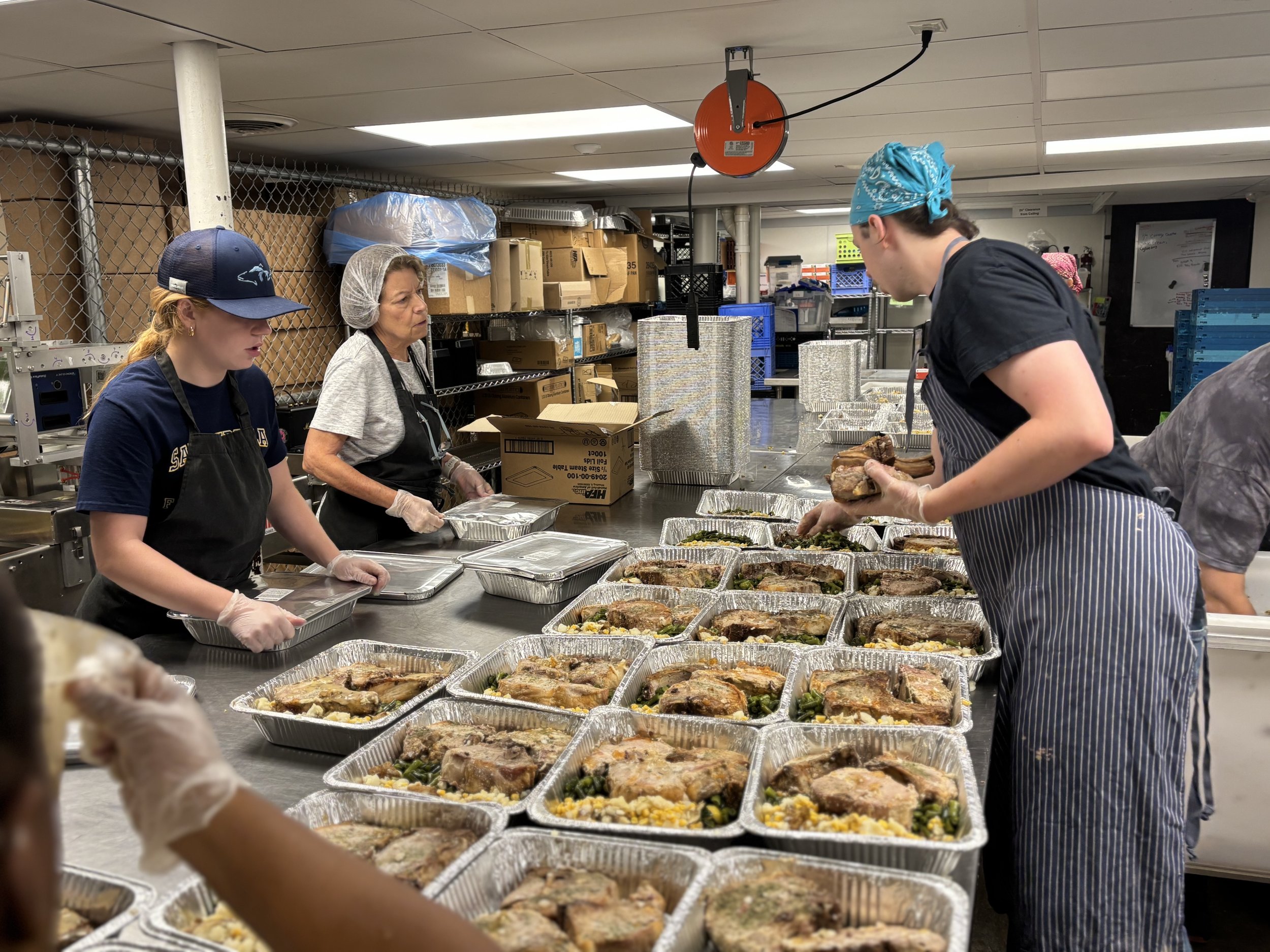
Volunteers assemble family meals at La Soupe
There’s an old question people ask when confronting a problem that feels impossibly large: How do you eat an elephant?
The answer is simple: one bite at a time.
Food insecurity in the United States can feel like that elephant. Millions of people struggle to access reliable meals every day. The scale of the problem is overwhelming. When you look at the statistics alone, it’s easy to believe the challenge is simply too big.
But inside a kitchen in Cincinnati, a group of chefs, volunteers, and staff approaches that problem differently.
They solve it one container of soup (soupe) at a time.
Over the past few weeks, I stepped away from my usual day job — which mostly involves strategy conversations, partnerships, and systems thinking — and joined the production floor at La Soupe, a nonprofit that rescues surplus food and transforms it into nutritious meals for the community.
My role changed depending on what the day needed.
Some mornings I worked the soupe line. Large batches of soup prepared earlier by the chefs were brought out from cold storage, and volunteers portioned them into containers for distribution.
My job in that process might be wiping containers, snapping lids into place, labeling them, stacking crates, and counting each set before they were rolled back into refrigeration.
Other days I found myself building sandwiches alongside volunteers — lining up bread, layering meats and cheese, squeezing condiments between layers so the bread wouldn’t get soggy, then packing and counting them into crates.
And sometimes the role was simply to float between stations — anticipating where help was needed so the production lines kept moving.
If a line slowed down, jump in.
If a team finished early, redirect them.
If something unexpected arrived — like a donation of massive frozen logs of ham that needed to be broken down before it could be processed — find the next best use of hands in the room.
In a place like La Soupe, the work rarely stays static.
Every day is different because the ingredients are different. The volunteers are different. The needs of the production floor are different.
But the rhythm of the work remains the same.
Small actions, repeated hundreds of times.
Wipe.
Lid.
Stack.
Count.
Or:
Build.
Wrap.
Label.
Crate.
By the end of a shift, those small actions add up to hundreds of meals moving out into the community.
And that’s when something clicked for me.
Large social problems rarely get solved through sweeping gestures. More often, they’re addressed through systems that allow people to contribute small, meaningful actions again and again.
At La Soupe, that system is constantly adapting.
Why I Started Writing These Field Notes
Over the past few weeks, I’ve been spending time inside La Soupe not just as a volunteer, but as a student of the system.
What I’ve found is more than a food rescue organization.
It’s a living example of how communities can build adaptive systems that tackle multiple challenges at once:
● food insecurity
● food waste
● nutrition and health
● cross-generational community building
● environmental sustainability
● dignified access to meals
All inside a 10,000 square foot kitchen that runs on a combination of professional staff, experienced volunteers, and a steady stream of rescued ingredients.
What surprised me most wasn’t that the operations were strong.
It was how often the system improvises.
Recipes change based on what food is rescued that week. Production lines get rearranged on the fly. Volunteers shift between tasks depending on where the bottleneck appears. Decisions are made quickly, adjusted when needed, and learned from for the next shift.
It’s organized chaos — the kind that only works because the people inside the system trust each other and understand the mission.
Watching it unfold, I was struck by something else.
In a moment when much of the world is captivated by artificial intelligence and automation, standing on that production line was a reminder that some of the most important work in society is still deeply human.
Technology can help optimize supply chains. It can help organizations analyze food waste patterns or coordinate distribution networks.
But the core of this work — the part that turns rescued food into meals and strangers into community — still happens through human hands.
And sometimes those hands are wiping soupe containers, snapping lids into place, and stacking crates fifteen at a time.
One container at a time.
Ramon stepped in as Interim Volunteer Coordinator at La Soupe and continues to share his time with us a regular volunteer. His series, Field Notes, offers a unique perspective of the work we are doing at La Soupe from behind-the-scenes. Learn more about Ramon and the exciting work he engages in to help others on his blog.