Field Notes: Jazz in a Rescue Kitchen
By: Ramon P. Lllamas, La Soupe Volunteer
At first glance, it looks like organized chaos. Volunteers move in different directions, conversations overlap across the room, music plays somewhere in the background, and ingredients are constantly being chopped, stirred, and repurposed.
It’s not immediately obvious how everything fits together—and yet, somehow, it does.
Not just functionally, but fluidly.
There’s a rhythm to it.
The best way I’ve found to describe La Soupe is this:
It operates like a jazz band.
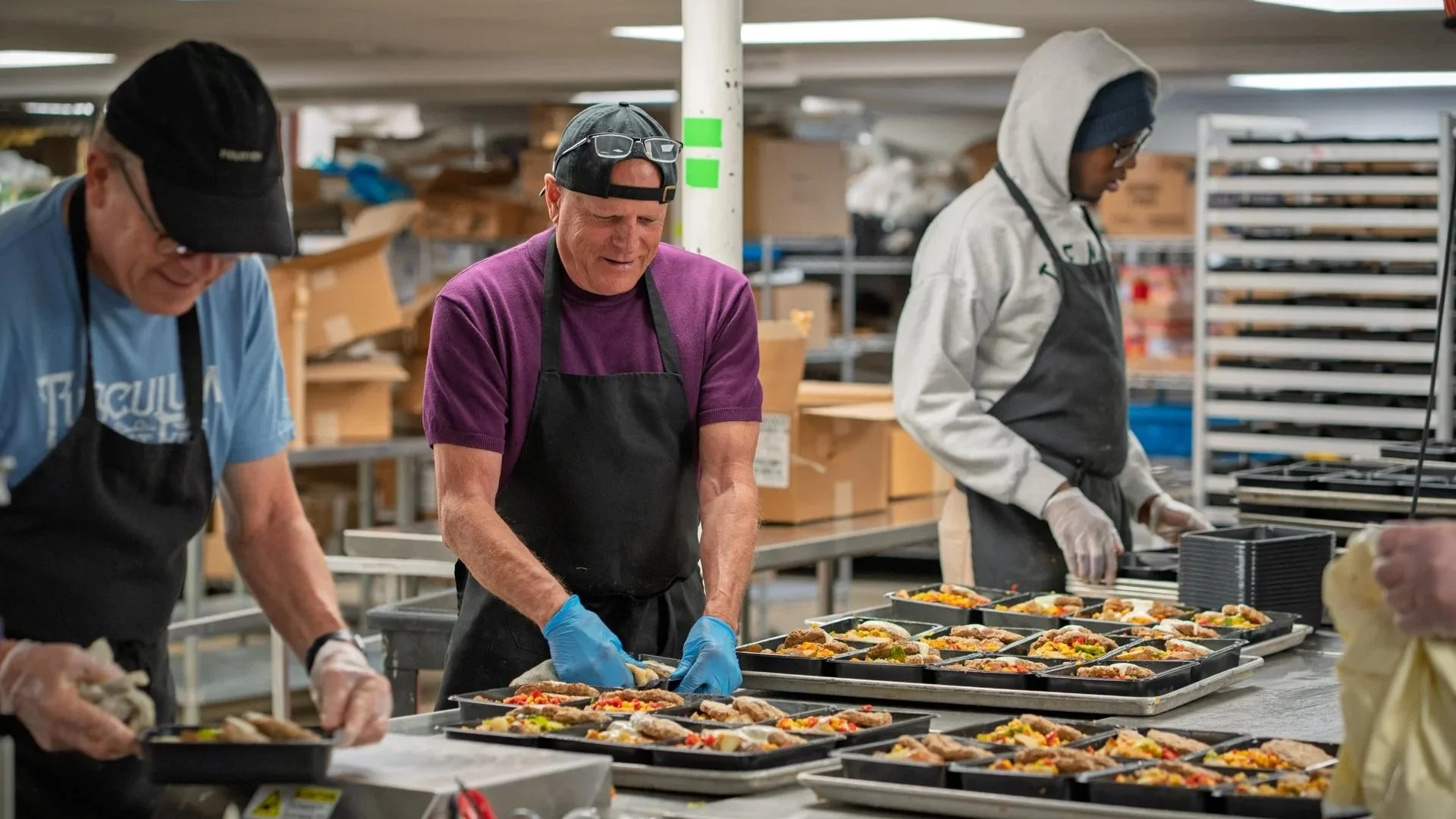
A volunteer prepares quick, nourishing meals for those in need.
There are core members
—the chefs, coordinators, and regular volunteers who have been showing up for years. They understand the system intuitively. They know the tempo, when to step in, when to step back, and how to keep things moving without needing explicit direction.
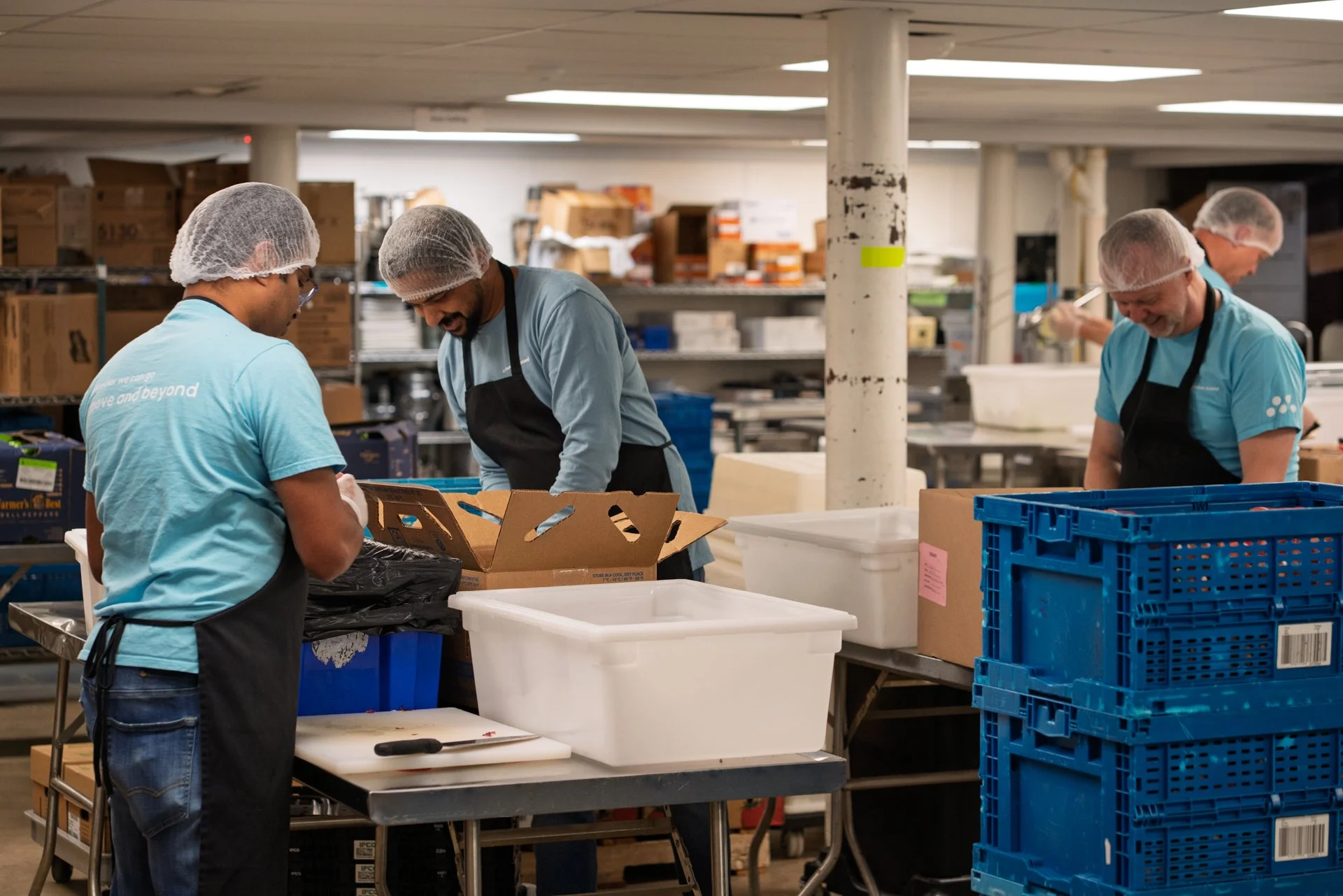
GE Credit Union volunteering at La Soupe in April, 2026.
Then there are the guest musicians.
Some are brand new. Some return occasionally. Others show up once and never again. And a few, over time, become part of the core. No two “sessions” are ever the same, because the people—and the inputs—are always changing.
The ingredients themselves are part of that unpredictability.
What arrives each day is what was rescued—surplus produce, excess inventory, food that would have otherwise gone to waste. There’s no fixed recipe waiting for it. No standardized playbook dictating exactly what comes next. Just a starting point.
From there, the chefs improvise.
One day, a batch leans toward a Thai-inspired broth. Another day, it becomes a roasted vegetable base layered with herbs and seasoning. Sometimes it’s light and clear; other times it’s thick—“thicker than a snicker,” as one chef put it. The goal isn’t perfection. It’s balance—flavor, nutrition, and the ability to produce at scale.
Once the soupe is ready, it moves downstairs.
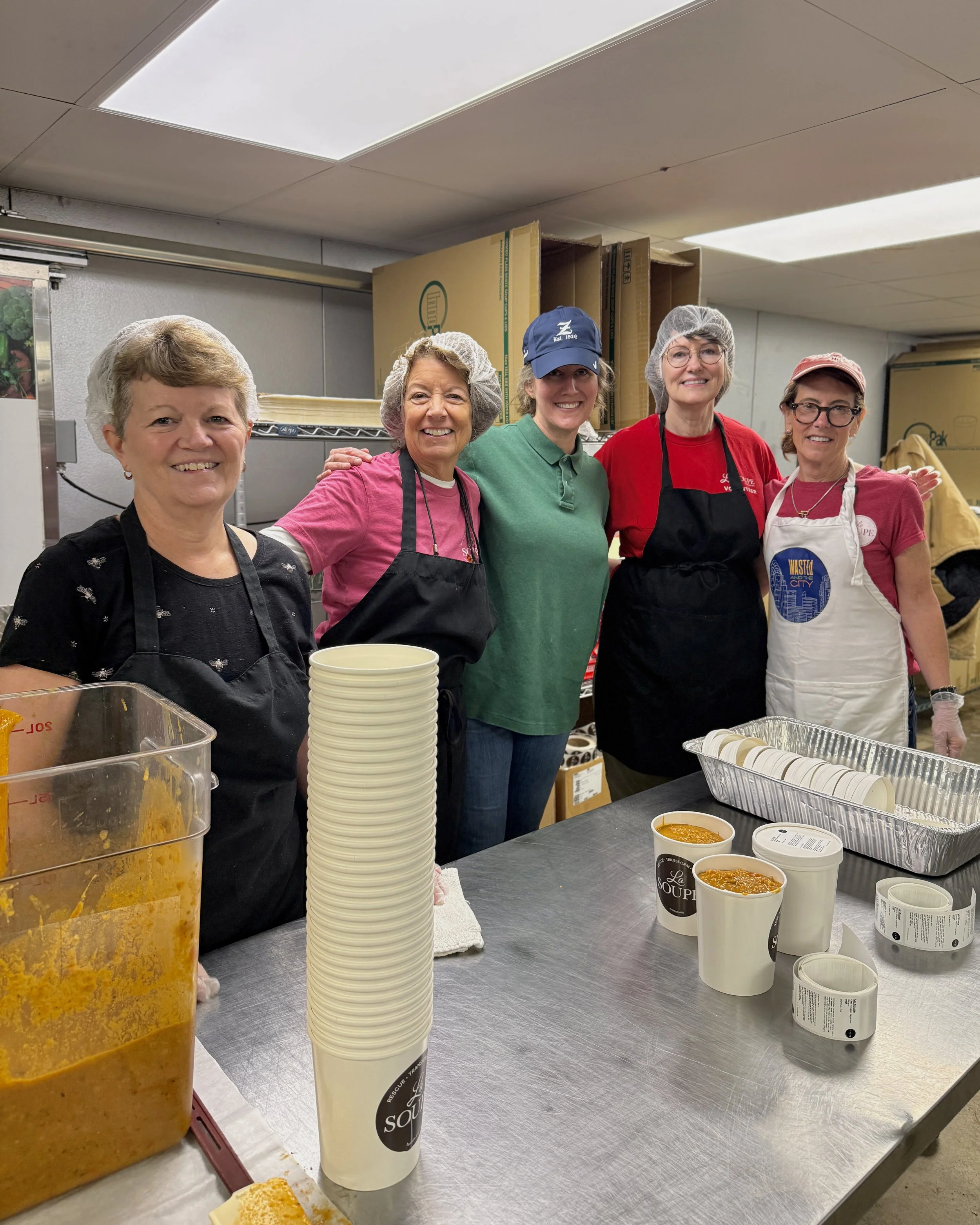
Upstairs, in the kitchen, the work feels creative—interpretive, even. Downstairs, on the production line, it becomes execution. But the rhythm doesn’t disappear. It just shifts.
One person pours. Another wipes. Another lids, labels, and stacks. New volunteers learn by doing, often guided by those who have been there before. Regulars adjust their pace without being asked. No one is waiting for instructions. Instead, they’re listening to each other, to the flow of the line, to the subtle cues that signal when to speed up, slow down, or step in.
At one point, a batch of soupe needed an adjustment.
It had come out too thick. The kitchen was upstairs, the production line was already in motion downstairs, and the timing was slightly off. Volunteers had arrived early, which meant the system was just a bit out of sync.
No one stopped.
There was no reset. No pause to rework the process from the beginning.
Instead, people adapted.
Water was heated upstairs and brought down. It was incorporated gradually, stirred in as the line continued moving. The soup changed in real time, adjusting without disrupting the overall flow. A few minutes later, the chef came downstairs, jumped in, tasted the batch, and added salt to make sure the flavor hadn’t been diluted.
Then the work continued.
No one panicked.
No one escalated the issue. No one called for everything to stop so it could be fixed “properly.”
They just played through it. That’s the difference.
Most systems are designed to eliminate variability.
La Soupe is designed to absorb it.
In a traditional production environment, unpredictability is treated as a problem to solve. Here, it’s the starting point. The constraint isn’t something to engineer away—it’s something to work with.
And that changes how people show up.
They’re not executing a script. They’re participating in something.
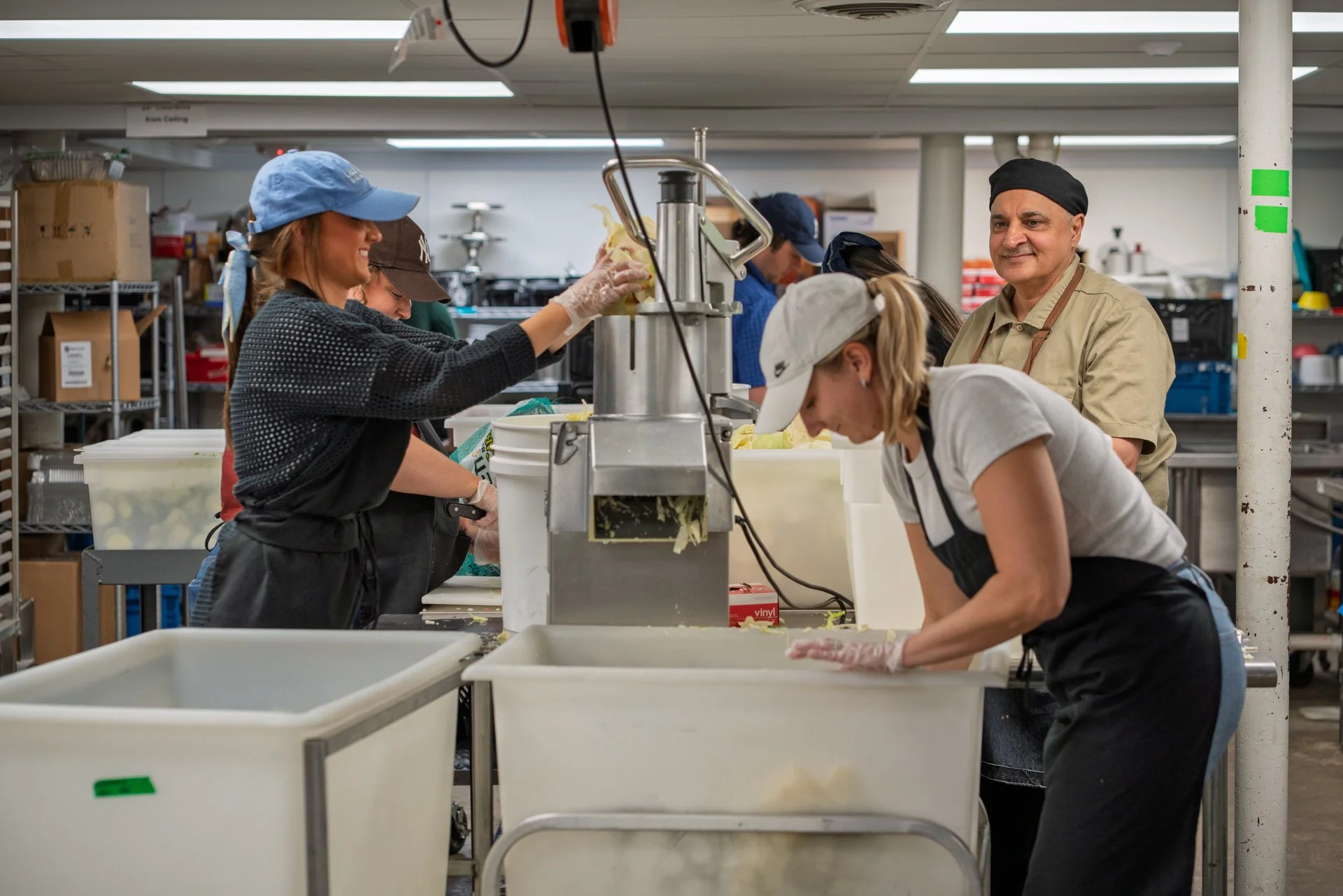
Chef Alae with volunteers at La Soupe.
There is structure, but it doesn’t feel heavy. There is leadership, but it isn’t centralized. Chef Alae runs the line downstairs, but he also sets the tone. Music plays throughout the shift. Energy stays high. At one point, the entire group—students, regular volunteers, and staff—found themselves singing along to “I Want It That Way” by Backstreet Boys while assembling hundreds of meals. In the middle of production. In the middle of work.
It sounds small, but it isn’t.
Because what’s happening in those moments isn’t just efficiency—it’s cohesion.
Fifteen people, all from different backgrounds and at different stages of life, moving together toward a shared goal. Not because they were told to, but because the system allows it.
This is what high-functioning human systems look like.
Not optimized for control, but designed for adaptability. The result is something most organizations struggle to achieve: consistency without rigidity. Meals get produced—at scale, with quality, and with speed. But the system doesn’t feel mechanical. It feels alive.
And that’s the part that’s hardest to replicate.
You can document the process. You can map the flow. You can write the playbook. But the real system—the one that actually works—is built on trust, awareness, shared responsibility, and a willingness to adjust in real time.
It’s not just a rescue kitchen.
It’s a daily exercise in collective improvisation.
And in a world increasingly optimized for predictability, automation, and control, that might be the thing worth preserving most.
Ramon stepped in as Interim Volunteer Coordinator at La Soupe and continues to share his time with us as a regular volunteer. His series, Field Notes, offers a unique perspective of the work we are doing at La Soupe from behind-the-scenes. Learn more about Ramon and the exciting work he engages in to help others on his blog.